
Best Hydroponic Nutrients UK: How to Choose Without Getting Overwhelmed

As an Amazon Associate we earn from qualifying purchases. This page contains affiliate links — if you buy through them, we earn a small commission at no extra cost to you.
Pouring standard UK tap water into a balcony hydroponics system is the easiest way to accidentally starve your plants. Hard water is the hidden constraint that turns the simple instruction to "just add nutrients" into a frustrating chemistry problem. You don't need a degree in plant science to fix this, but you do need to stop buying US-calibrated formulas that clash with British mains water. The fix comes down to matching your nutrient brand to your local water hardness.
Why Does UK Water Change Which Nutrients You Need?
UK tap water is often hard, meaning it contains high levels of calcium and magnesium that push the pH above 7.0. When you add standard hydroponic nutrients to alkaline water, essential minerals like iron and phosphorus bind together and become unavailable to the plant. This causes nutrient lockout, leading to yellowing leaves and stunted growth.
US-market formulas are usually calibrated for soft water with a pH around 6.5. They include buffering agents that assume low calcium. In a typical London or South East supply, where hardness regularly exceeds 250 mg per litre, those same formulas push the solution into the alkaline zone.
The Royal Horticultural Society (RHS) notes that highly alkaline water reduces the availability of essential nutrients and increases the risk of leaf chlorosis. This is exactly the yellowing many UK beginners see. A thread on a popular UK growing forum recounts a flat-dweller whose lettuce turned yellow despite following the label dosage, only after they tested the water and discovered a pH of 8.2.
The solution is to choose nutrients that either tolerate hard water or come with clear guidance on pH adjustment.
Download the free vertical gardening quick reference – it includes a simple water-testing cheat sheet you can print and keep beside your reservoir.
Stage 1: The Veg Stage (Leaf Growth)
Leafy greens thrive on nitrogen. For a UK DWC system using hard tap water, aim for an NPK ratio around 3:1:2 (or 4:1:3 if you are pushing fast growth). The key is finding a formulation that supplies calcium-chelated iron and includes a pH stabiliser.
Here is how the main options handle the vegetative growth phase:
- Gro-Smart Veg – the best value choice, widely stocked at B&Q and online. It is cheaper than most specialist lines, but because it lacks a built-in chelator you will want to check pH daily and dose a little extra iron if the leaves start to pale.
- Canna Aqua Vega – sits in the premium bracket (£30–£45 for a 5 L bottle). It contains EDTA-chelated micronutrients that stay soluble even when calcium is high, so you can keep the dosing schedule simple.
A common mistake that bubbles up on UK forums is over-feeding the veg mix because the plants look healthy. The reality is that excess nitrogen in hard water accelerates algae growth in the reservoir, leading to clogged pumps. Stick to the lower end of the recommended dosage until you have confirmed a stable pH between 5.5 and 6.5.
Stage 2: The Flower Stage (Fruit & Bud)
When you move to tomatoes, peppers or strawberries, the nutrient balance flips. Phosphorus and potassium become the priority. Look for an NPK of 1:2:3 or a bloom booster that adds magnesium. Hard water already supplies calcium, so you do not need to overdose it.
The reliable choices for the flowering stage in UK water are:
- Shogun Flower – a UK-formulated blend that handles alkaline water without a dramatic pH swing. Users on the Shogun forums report sweeter fruit and fewer blossom-drop issues, even when the reservoir pH initially reads 7.8. It sits at about £45–£55 for 5 L.
- Canna Aqua Flores – the counterpart to Aqua Vega, priced similarly. It includes a higher potassium source (potassium nitrate) that works well in hard water, but you will still need a pH-down solution to bring the final mix into the 5.5-6.5 window.
Beware the sudden spike in nutrient concentration when you switch formulas too quickly. The safe route is a three-day overlap: keep the veg mix at 70% of the recommended dose while you introduce the bloom mix at 30%, then gradually invert the ratios.
The “Safe Bet” Shortlist (UK Brands)
These four brands consistently perform across UK grow-shop reviews, water-hardness tests, and real-world grower feedback.
- Gro-Smart – Pros: inexpensive (£20–£30 for a starter 5 L pack), widely available in garden centres, simple dosing chart. Cons: lacks chelated micronutrients, so you may need an extra iron supplement in very hard water.
- Shogun – Pros: formulated for alkaline tap water, includes built-in pH stabiliser, organic-friendly. Cons: price is higher (£45–£55) and the bottle is heavier, which can be a minor inconvenience for balcony lifts.
- Canna – Pros: “gold standard” reliability, EDTA-chelated trace elements stay soluble, excellent for both veg and flower phases. Cons: not cheap (£30–£45 per 5 L) and the brand leans on a more complex feeding schedule that can feel like a bit of a faff for absolute beginners.
- Bio-Bizz – Pros: 100% organic, great for growers wanting a soil-like feel in hydroponics. Cons: highly sensitive to hard water – many owners report rapid pH drift unless they pre-adjust tap water with a reverse-osmosis unit.
These brands are stocked by specialist UK retailers such as Progrow, Holland Hydroponics, and even larger chains like Wilko. You can read more about how we evaluate systems and growing gear on our about the SolisStrata Team page.
Troubleshooting: Fixing Nutrient Lockout
Lockout shows up as yellow tips, curling leaves, or a sudden halt in growth. The first thing to do is grab a pH meter or a liquid test kit and check the solution. In most UK homes the target is 5.5–6.5; anything above 7.0 is a red flag.
How to Diagnose and Fix Nutrient Lockout
Step 1: Measure the reservoir pH
If the reading sits above 7.0, add a pH-down solution. Phosphoric acid is the standard choice for hydroponics. Add it drop by drop, waiting ten minutes before testing again to avoid overshooting the target.
Step 2: Inspect your water hardness
A simple test strip will tell you if calcium is above 200 mg per litre. If your water is exceptionally hard, you may need to switch to a hard-water specific nutrient line rather than constantly fighting the daily pH drift.
Step 3: Look for algae growth
If the water is cloudy or smells stagnant, a brief flush can reset the system. Mix fresh tap water, adjust the pH, run the pump for ten minutes, and then drain it entirely before adding your fresh nutrient solution.
Step 4: Review your dosing
Reduce the nutrient concentration by 20% and re-measure after 24 hours. Plants recover far better from slight under-feeding than they do from a heavy lockout caused by excessive mineral buildup in the reservoir.
Owners repeatedly note that the most common error is forgetting to adjust pH after a water change. The solution is belt and braces: keep a small bottle of pH-down on the bench and add a few drops each time you top up the reservoir.
UK Hydroponic Nutrients: Quick Comparison
Not sure where to start? Here is a snapshot of the four brands mentioned above with direct links to check current UK pricing.
| Brand | Best for | Hard water? | Where to buy |
|---|---|---|---|
| Canna Aqua Vega (paid link) | Leafy greens, veg stage | ✓ EDTA-chelated | Amazon UK |
| Shogun Flower (paid link) | Tomatoes, peppers, fruiting | ✓ UK-formulated | Amazon UK |
| pH Down Solution (paid link) | Correcting alkaline tap water | Essential with any nutrient | Amazon UK |
Prices and availability change — always check the product page before ordering.
Common Questions
Can I use tap water directly in my hydroponic system?
Yes, but you must test and adjust the pH first. UK tap water often sits at pH 8 or higher, which locks out nutrients. Use a pH-down solution to bring it into the 5.5–6.5 range before mixing in any liquid or powder feed.
What is the difference between liquid and powder nutrients?
Liquid nutrients are pre-mixed and easier to measure quickly, though they cost more per litre. Powder nutrients are cheaper and have a longer shelf-life, but they require a digital scale for accurate dosing. A small mistake with powder can easily lead to over-feeding in a small balcony reservoir.
Do I need different nutrients for leafy greens versus tomatoes?
Absolutely. Leafy greens need a higher nitrogen ratio (around 3:1:2) to push rapid leaf expansion. Fruiting crops like tomatoes or chillies require more phosphorus and potassium (about 1:2:3) to support blossom and fruit set.
Are UK grow-shop nutrients better than supermarket ones?
Yes, for hydroponics. Supermarket mixes are almost always designed for soil and lack the specific chelated micronutrients that stay soluble in water. Using soil fertilisers in a closed-loop system usually causes salt buildup and premature pump failures. If you are struggling to find the right supplies locally, feel free to get in touch for UK supplier recommendations.
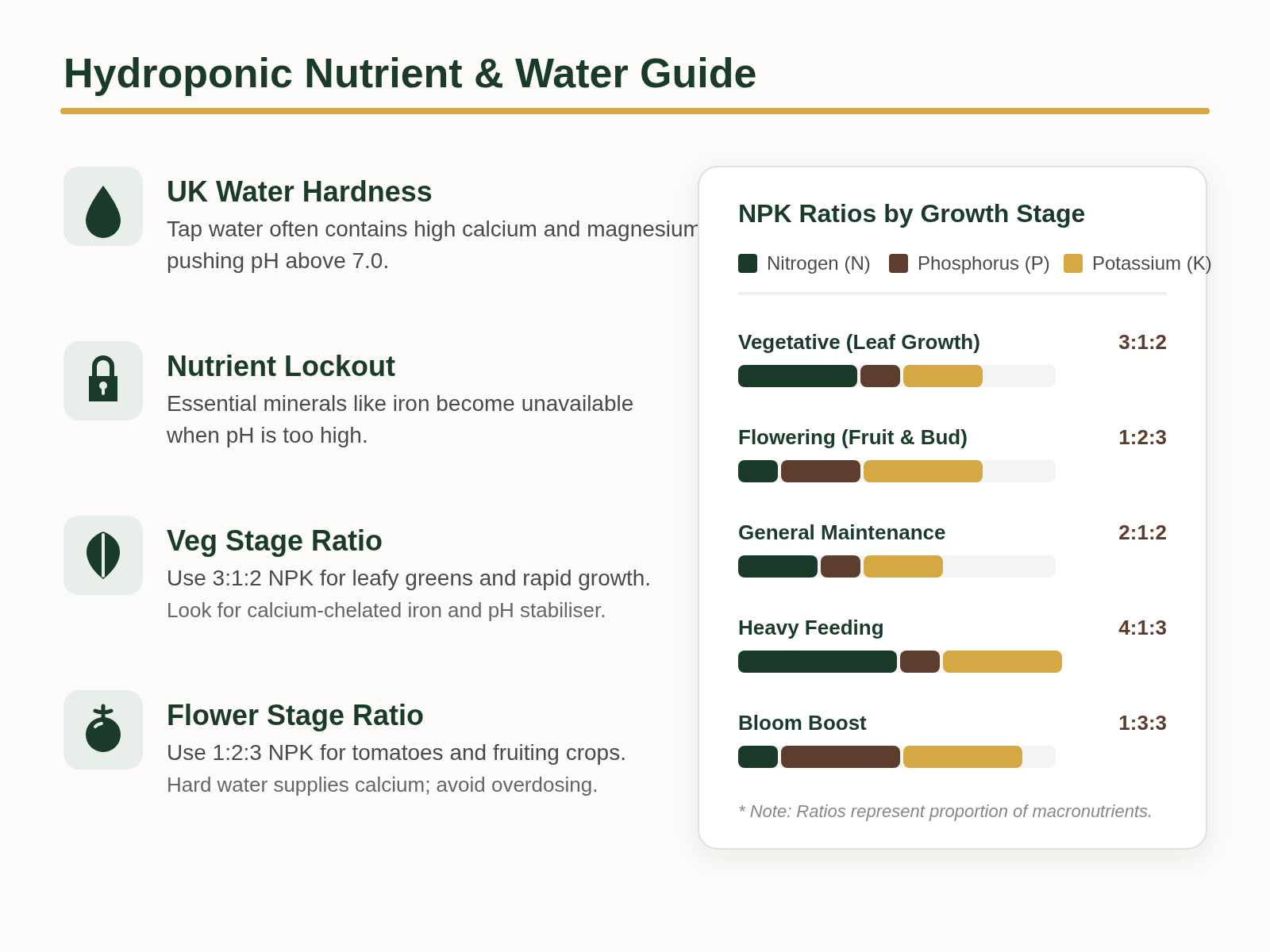
UK Hydroponic Nutrient NPK Ratios
| Growth Stage | Primary Nutrient Focus | Recommended NPK Ratio | Notes |
|---|---|---|---|
| Vegetative (Leaf Growth) | Nitrogen | 3:1:2 or 4:1:3 | Look for calcium-chelated iron and pH stabiliser |
| Flowering (Fruit & Bud) | Phosphorus & Potassium | 1:2:3 | Hard water already supplies calcium, so avoid overdosing |
| General Maintenance | Balanced | 2:1:2 | Suitable for most leafy greens and herbs |
| Heavy Feeding | Nitrogen Boost | 4:1:3 | For fast growth in optimal conditions |
| Bloom Boost | Potassium Boost | 1:3:3 | For heavy fruiting crops like tomatoes |
| Low Light | Nitrogen Focus | 5:1:1 | For slow growth or low-light environments |
| High Light | Nitrogen Focus | 3:1:1 | For rapid growth in high-light conditions |
What to Do Now
You now have the three UK-ready nutrient families, the right NPK ratios for veg and flower stages, and a simple lockout-fix checklist. The next step is to pick a brand that matches your budget and start testing your tap water.
If you’d like a printable cheat sheet that walks you through pH testing, dosing schedules, and a quick-look water-hardness chart, download the free vertical gardening quick reference. It’s a compact tool you can keep on the balcony shelf for fast reference.
Grow confidently, keep the chemistry simple, and enjoy fresh herbs and fruit straight from your flat – no science degree required.
As an Amazon Associate we earn from qualifying purchases. The nutrients linked above are ones we recommend based on independent research and UK grower feedback.
Related Guides
Nutrients only make sense once the system is chosen. Start with which hydroponic system fits a UK home, then the cheapest way to start under £30 if you are still on a bucket. If leaves yellow after mixing, use how to fix pH crashes, algae and root rot before buying a different bottle.
For kit rather than bottles, see hydroponics equipment for beginners.
Further Reading
- Royal Horticultural Society (RHS)
- Hydroponics UK Forum
- Growing Advice – Hydroponics Direct
Note: This guide provides general information based on UK water hardness and nutrient chemistry. Always verify specific product instructions and local water test results before application. For critical growing operations, consult a qualified horticulturalist or the manufacturer's technical support.

Bob is the publisher. We are a UK-based resource for simplifying complex topics to the world of small-space and container gardening. Helping UK gardeners get the most out of their balconies and patios. You can read our full story on the About the Author page.