
Is NFT Hydroponics Worth It for UK Small Spaces?

As an Amazon Associate we earn from qualifying purchases. This page contains affiliate links — if you buy through them, we earn a small commission at no extra cost to you.
Nutrient Film Technique (NFT) systems look sleek on retailer websites, promising huge yields from a tiny footprint. For a UK flat, the reality is more grounded. While NFT is brilliant for squeezing dozens of lettuces into a space that would normally hold a single pot, it is not a set-and-forget option. It relies on constant water flow and electricity, which means managing a few specific quirks.
What is NFT Hydroponics? (The Basics)
NFT (Nutrient Film Technique) is a hydroponic method where a continuous, millimetre-deep stream of nutrient-rich water flows over bare plant roots inside a sloping channel. The roots sit in this very thin film, allowing them to absorb oxygen from the air while taking up water and nutrients.
Compared with Deep Water Culture (DWC), where roots sit in a static reservoir, or drip systems that periodically flood plants, NFT’s constant flow lets you build the entire setup vertically. That vertical stacking is why it’s heavily marketed as a space-saving solution for balconies and indoor walls. You can find more on how this compares to other methods in our main blog index.
The “Worth It” Verdict: Pros vs. Cons for UK Growers
Yes, if… you have a sunny balcony or a well-lit window, you’re comfortable checking a water pump weekly, and you want significantly higher yields than a standard soil pot delivers. The vertical layout means you can grow dozens of lettuce heads or basil stalks on a 1 m × 0.3 m channel.
No, if… you’re renting with strict lease rules on water features, you hate routine cleaning, or you want a system you can ignore for weeks. The most common failure point reported across UK hydroponic forums is clogging. Debris, root fragments, or algae block the channel, stopping the water flow and killing the crop within hours. Skipping the weekly flush usually results in a green algae soup that spreads through the whole system.
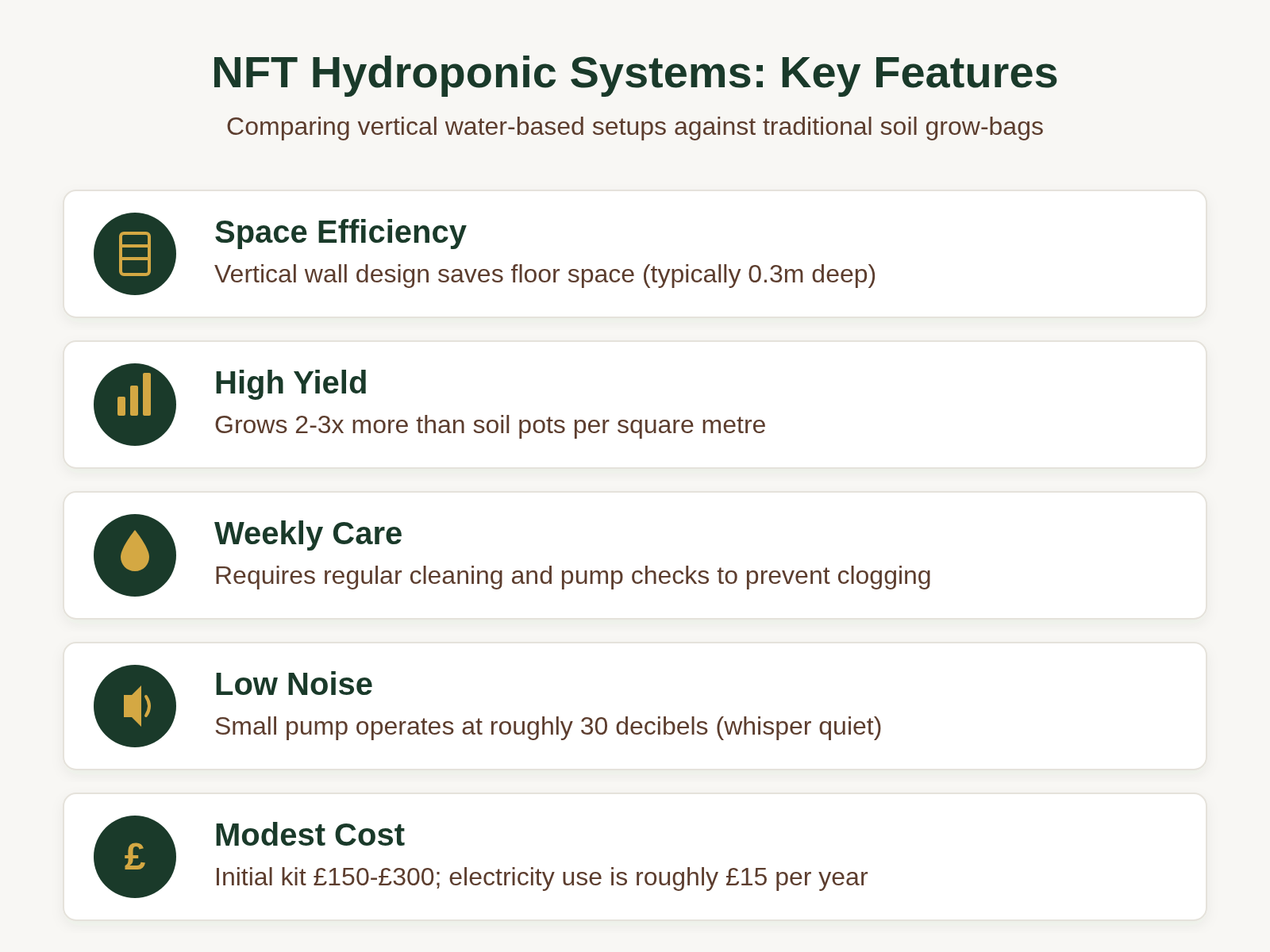
| Factor | NFT | Typical Grow-Bag |
|---|---|---|
| Space use | Vertical wall, 0.3 m deep | Horizontal, needs floor space |
| Yield (per m²) | 2–3 × soil | 1 × soil |
| Maintenance | Weekly cleaning, pump check | Occasional water top-up |
| Noise | Small pump (~30 dB) | None |
| Cost (initial) | £150–£300 kit | £20–£40 grow-bag set |
The bottom line: NFT offers superior space efficiency and faster growth, but it demands regular attention. If you’re willing to treat the system like a kitchen appliance—clean it weekly, keep an eye on the pump—the payoff is definitely there.
The “Hidden” Costs: Electricity & Water in the UK
Running a 5 W submersible pump (paid link) 24 hours a day sounds trivial, but you should factor the cost in. Based on recent Ofgem energy price caps, running a standard micro-pump costs roughly:
Check the 5 W mini pump, 350 L/h price
- Daily: 5 W × 24 h = 0.12 kWh → around £0.03 to £0.04 a day.
- Yearly: £12 to £15 per year.
Water consumption is low because the system recirculates. You’ll still need to top up the reservoir every few weeks to replace evaporated water and keep the nutrient concentration balanced. For a typical 10-litre loop, the extra water cost is negligible—usually under £2 a month, depending on your regional water rates.
Compared to a simple grow-bag, the utility bill for an NFT setup is modest. If you’re on a tight electricity budget, just factor that £15 annual cost into your expectations.
Balcony Regulations & Space Limits
UK balconies have specific load-bearing limits. Modern residential balconies are typically designed to hold around 1.5 to 2 kN/m² (roughly 150–200 kg per square metre), but older properties or specific leasehold agreements often restrict this further. A fully filled NFT channel—factoring in water, the plastic housing, and mature plants—can weigh up to 30 kg for a 1-metre length. A single channel is usually fine, but stacking multiple tiers requires careful placement near load-bearing walls.
Many lease agreements explicitly forbid permanent water features on balconies due to the risk of leaks damaging the flats below. Before buying anything, check your tenancy agreement or ask your building manager if water-based systems are permitted.
Noise is the other hidden factor. Even a quiet 5 W pump produces a low-frequency hum that travels easily through flat floors, especially at night. A simple fix is to sit the pump on a rubber mat or inside an insulated box.
Checklist before buying:
- Verify the balcony’s load limit.
- Confirm the lease permits water-based installations.
- Measure the distance from the pump to the nearest neighbour’s bedroom—consider a silent-pump model if needed.
Maintenance Reality: The Clogging Fear
Algae thrives wherever light hits nutrient-rich water. Most owners seal the top of their channels with an opaque lid, but if light leaks in, a thin film of algae can develop in a fortnight. This turns the channel into a slippery mess that blocks the flow.
Root blockages are the other common headache. As plants mature, their root systems expand and can easily infiltrate the pump inlet. If the pump runs dry, it overheats and fails.
The maintenance schedule that keeps an NFT system running smoothly is:
- Weekly: Flush the channel with clean water, scrape away any visible algae, and check the pump suction for stray roots.
- Monthly: Drain and replace the nutrient solution entirely, inspect the tubing for cracks, and verify the flow rate is still strong.
that NFT is not a low-maintenance setup. It’s only "maintenance-light" if you stick strictly to the weekly routine.
Who Should Actually Buy This? (The Final Verdict)
Best suited for:
- Experienced growers who understand hydroponic basics.
- Flat owners with a balcony that meets weight and lease criteria.
- Anyone who values higher yields and is comfortable with weekly cleaning.
Not for:
- First-time hydroponic beginners looking for a plug-and-play solution.
- Renters whose tenancy agreement bans water installations.
- People who want a completely hands-off garden.
If you decide to try NFT, start with a pre-assembled kit rather than a DIY PVC build. Kits from UK hydroponic retailers usually include a properly sealed channel, a low-noise pump, and a starter nutrient pack, which removes a lot of the guesswork and reduces the risk of early failures.
Frequently Asked Questions
Can I build an NFT system myself cheaply?
You can assemble a DIY version using standard PVC downpipes, a small aquarium pump, and a plastic storage box for the reservoir. However, pre-made kits are generally more reliable for beginners because the channels are properly sealed against light, which stops algae taking over.
Do NFT systems use a lot of electricity?
No, the water pump typically draws only 5W, which costs around £15 a year at current UK energy rates. The real electricity cost only comes into play if you add indoor grow lights; the water circulation itself is very cheap to run.
What happens if the pump breaks?
If the pump stops, the thin film of water disappears immediately and the bare roots dry out. In an NFT setup, a failed pump can kill your entire crop within a few hours on a warm day. Keeping a cheap spare pump in the cupboard is a highly recommended belt-and-braces measure.
Is NFT better than soil for balconies?
Yes, primarily for space efficiency and keeping the area clean. Soil pots inevitably leak muddy water and take up valuable floor space, whereas an NFT system keeps the growing medium completely contained and utilises vertical wall space.
NFT vs Grow-Bag: Quick Comparison
| Feature | NFT System | Typical Grow-Bag |
|---|---|---|
| Space Use | Vertical wall, 0.3m deep | Horizontal, needs floor space |
| Yield (per m²) | 2–3x soil | 1x soil |
| Maintenance | Weekly cleaning, pump check | Occasional water top-up |
| Noise | Small pump (~30 dB) | None |
| Initial Cost | £150–£300 kit | £20–£40 set |
Before You Buy
You now have the facts. NFT can squeeze a highly productive garden onto a narrow balcony, but it demands weekly checks, a modest electricity bill, and strict compliance with your lease rules. If those conditions fit your living situation, the system pays off in fresh produce all year round.
Ready to see whether your specific space meets the criteria? Download the free vertical gardening quick reference – it walks you through the key measurements, cost checks, and regulatory points you need before you spend on a kit.
If you still have questions about setting up your first system, reach out to the team via our email. Happy growing, and may your balcony stay dry and your lettuce stay crisp.
Related Guides
For a complete overview, see our Hydroponics for UK Home Growers: Which System Actually Suits Your Space?.
Further Reading
- Royal Horticultural Society (RHS)
- Ofgem (Energy Price Cap)
- UK Government Building Regulations
As an Amazon Associate we earn from qualifying purchases. The products linked above are ones we recommend based on independent research and owner feedback.
Note: General guidance only, verify details with a qualified professional or official source.
You may also like
Other listings for the same job.
- AQQA air pump, 12 W (paid link)
- 24-hour plug-in timer (paid link)
- 100 rockwool cubes (paid link)

Bob is the publisher. We are a UK-based resource for simplifying complex topics to the world of small-space and container gardening. Helping UK gardeners get the most out of their balconies and patios. You can read our full story on the About the Author page.